



CHINESE LANGUAGE PROGRAM AT DAV
The Chinese Language Program at the Diplomatic Academy of Vietnam (DAV) is designed for all students across the DAV’s degree programs, meeting the growing demand for foreign language competence in the context of deepening international integration. Students may choose Chinese as Foreign Language 1 or Foreign Language 2, following a flexible progression across three levels: Elementary, Intermediate, and Advanced, determined through a placement test combined with HSK results or achievements in Chinese competitions at provincial or national level. The curriculum offers a comprehensive system of courses, ranging from General Chinese Language I–IV to a series of Specialized Chinese Language for Specific Purposes I–VI, covering listening, speaking, reading, and writing skills, as well as academic Chinese, specialized Chinese, and basic translation and interpreting skills for foreign affairs. In addition, students may select elective modules such as Chinese Studies, Business Chinese Oral Communication, to broaden their understanding of Chinese culture, economy, trade, and society. With a flexible credit structure tailored to each major and proficiency level, the Chinese Language Program at the Diplomatic Academy of Vietnam not only provides a solid linguistic foundation but also aims to develop students’ ability to apply Chinese effectively in diplomacy, international economics, and various fields of international cooperation.
COURSE UNIT: GENERAL CHINESE LANGUAGE I
(For all bachelor programs, issued under Decision No1712/QĐ-HVNG dated September 22, 2023 updated to September 2025)
This course serves as the foundation for students to develop four essential language skills: Listening, Speaking, Reading, and Writing for basic communication. In this course, students practice listening to simple sentences and dialogues at a slow pace, focusing on accurate pronunciation, simulating, and practicing speech from individual words to short sentences. They also practice recognizing and writing Chinese characters, develop reading comprehension skills, and grasp the main ideas in short texts or dialogues. These materials are related to familiar, everyday life topics.
(i) Listening Skills: Students will be able to understand very simple sentences spoken at a slow pace with clear and accurate pronunciation. They will comprehend simple instructions and announcements at a slow speed. Additionally, they will understand short dialogues with basic sentence structures, spoken slowly and clearly, on topics such as personal information, family, classroom settings, and other essential situations.
(ii) Speaking Skills: Students are required to pronounce clearly and accurately the words, phrases, and sentences learned. They should be able to use vocabulary, phrases, and sentences to introduce basic information about themselves and their families, such as name, place of residence, and engage in basic activities like greetings, introductions, sending mail, and withdrawing money.
(iii) Reading Skills: Students will be able to read nearly 400 vocabulary words, phrases, and simple sentences related to the topics covered in the course. They will develop the ability to understand and summarize the content of short texts, which are related to familiar life situations.
(iv) Writing Skills: Students will learn the rules of writing Chinese characters, become familiar with basic radicals, and be able to write simple words, phrases, and sentences. Through exercises of increasing difficulty, students will progress from writing sentences to composing short paragraphs (approximately 150 words) on basic topics.
Upon completion of this course, students will achieve a basic level of Chinese proficiency, corresponding to A1 on the Common European Framework of Reference for Languages (CEFR) and Level 1 in the Ministry of Education and Training’s proficiency framework.
2.2 Course learning outcomes (CLOs):
Upon completion of the course, students will be able to:
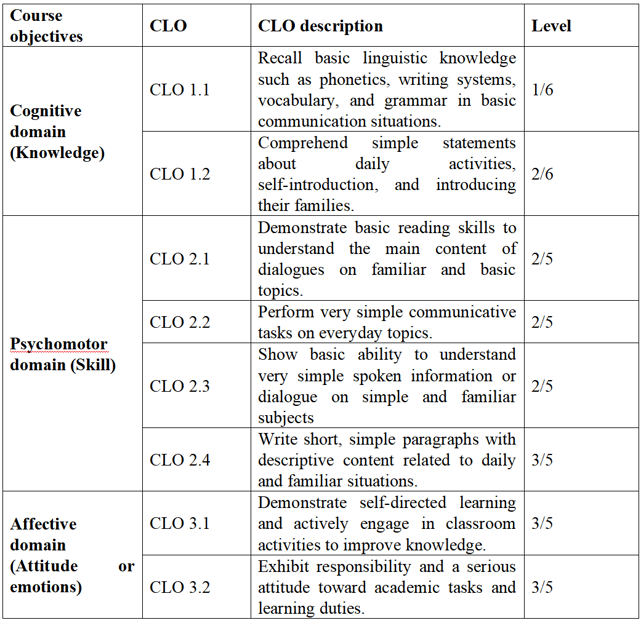
Note: The level is defined based on Bloom’s Taxonomy for Cognitive domain: Knowledge (1-6), Dave’s Taxonomy for Psychomotor domain: Skill (1-5), Krathwohl’s Taxonomy for Affective domain (1-5).
COURSE UNIT: GENERAL CHINESE LANGUAGE II
(For all bachelor programs, issued under Decision No1712/QĐ-HVNG dated September 22, 2023 updated to September 2025)
This course continues to provide and consolidate vocabulary and expression structures such as comparative and superlative forms, perfect tense, past tense, near future tense, as well as various types of complements (resultative, directional, degree, state, and potential complements, etc.), serving communication in daily situations and socio-professional contexts. The course is delivered over 30 sessions, equivalent to 90 class periods. Upon completion of this course, students will achieve Chinese proficiency level III, equivalent to level B1 of the Common European Framework of Reference for Languages (CEFR) and Level 3 of the proficiency framework set by the Ministry of Education and Training.
2.2 Course learning outcomes (CLOs):
Upon completion of the course, students will be able to:
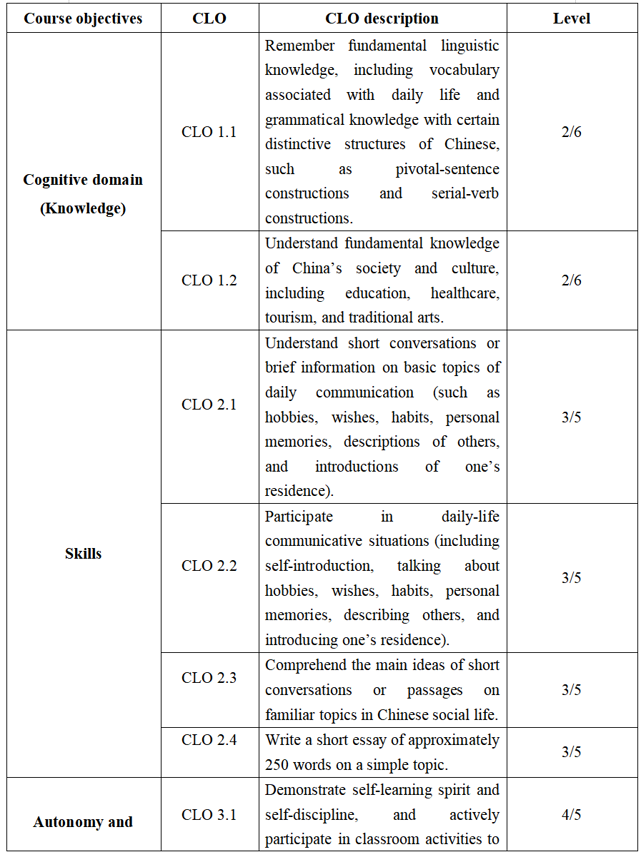
Note: The level is defined based on Bloom’s Taxonomy for Cognitive domain: Knowledge (1-6), Dave’s Taxonomy for Psychomotor domain: Skill (1-5), Krathwohl’s Taxonomy for Affective domain (1-5)
COURSE UNIT: GENERAL CHINESE LANGUAGE III
(For all bachelor programs, issued under Decision No1712/QĐ-HVNG dated September 22, 2023 updated to September 2025)
This course continues to provide and consolidate vocabulary and expression structures such as comparative and superlative forms, perfect tense, past tense, near future tense, as well as various types of complements (resultative, directional, degree, state, and potential complements, etc.), serving communication in daily situations and socio-professional contexts. The course is delivered over 30 sessions, equivalent to 90 class periods. Upon completion of this course, students will achieve Chinese proficiency level III, equivalent to level B1 of the Common European Framework of Reference for Languages (CEFR) and Level 3 of the proficiency framework set by the Ministry of Education and Training.
2.1 Course learning outcomes (CLOs):
Upon completion of the course, students will be able to:
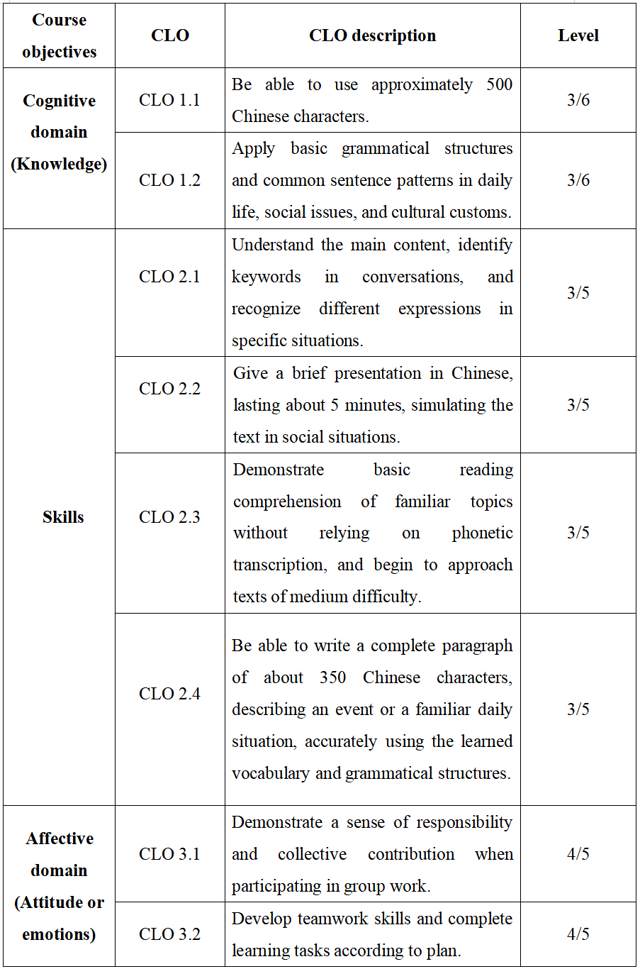
Note: The level is defined based on Bloom’s Taxonomy for Cognitive domain: Knowledge (1-6), Dave’s Taxonomy for Psychomotor domain: Skill (1-5), Krathwohl’s Taxonomy for Affective domain (1-5)
COURSE UNIT: GENERAL CHINESE LANGUAGE IV
(For all bachelor programs, issued under Decision No1712/QĐ-HVNG dated September 22, 2023 updated to September 2025)
This course enables students to identify and apply knowledge of Chinese phonetics, writing, intermediate grammar, and common communicative expressions in everyday situations. It aims to consolidate intermediate-level Chinese for daily communication, introduce complex and advanced grammatical structures, and provide practice in dialogues through textbook-based simulations to strengthen students’ ability to use the language in social interaction.
The course also develops students’ reading and writing skills at the intermediate level: the ability to read Chinese characters without phonetic transcription, to understand the cultural content presented in the textbook, and to compose paragraphs on both studied topics and everyday life themes.
2.2 Course learning outcomes (CLOs):
Upon completion of the course, students will be able to:
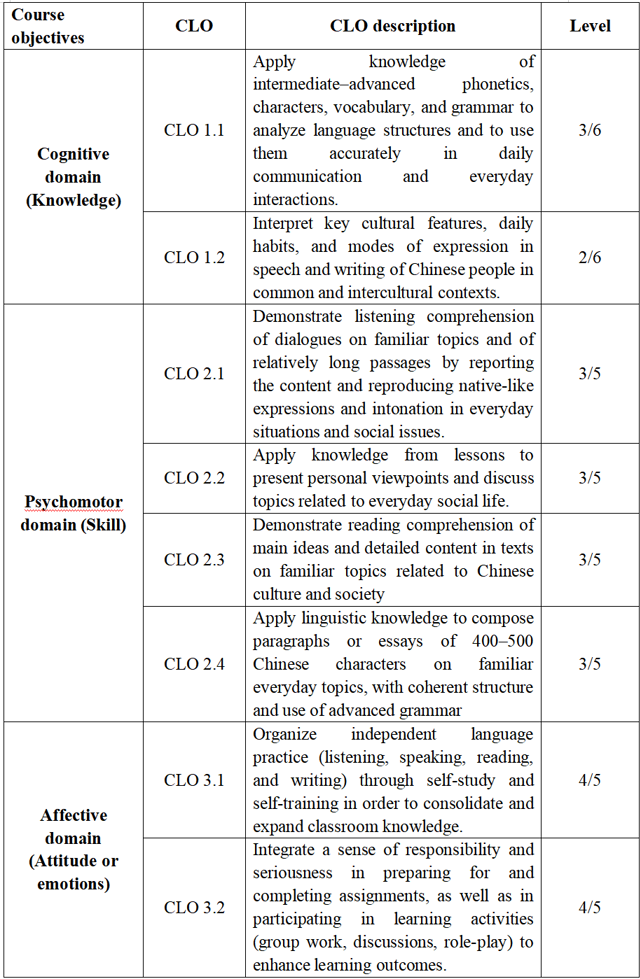
Note: The level is defined based on Bloom’s Taxonomy for Cognitive domain: Knowledge (1-6), Dave’s Taxonomy for Psychomotor domain: Skill (1-5), Krathwohl’s Taxonomy for Affective domain (1-5).
COURSE UNIT: CHINESE LANGUAGE FOR SPECIFIC PURPOSES I
(For all bachelor programs, issued under Decision No1712/QĐ-HVNG dated September 22, 2023 updated to September 2025)
This course is designed to equip students with fundamental approaches to reading news articles on topics such as courtesy visits, talks, and conferences from international journals (e.g., The People’s Daily, Xinhua News Agency), and to listening to current news broadcasts at a relatively slow speed. Through this, students develop methods for sourcing materials and comprehending international issues. Students are initially introduced to the basic principles of transferring information from Chinese into Vietnamese and from Vietnamese into Chinese.
Upon completion of the course, students will acquire vocabulary, knowledge, and skills through a structured system of exercises and questions. They will be able to apply essential diplomatic vocabulary to express preliminary assessments and personal viewpoints on the studied issues, and to produce simple summaries of social information. Students will be able to understand the content of slow-paced news reports and respond to related questions. Moreover, they will gain a deeper understanding of political and social issues in China, develop an interest in exploring these topics further, and actively seek similarities and differences between the political and social systems of China and Vietnam.
2.2 Course learning outcomes (CLOs):
Upon completion of the course, students will be able to:
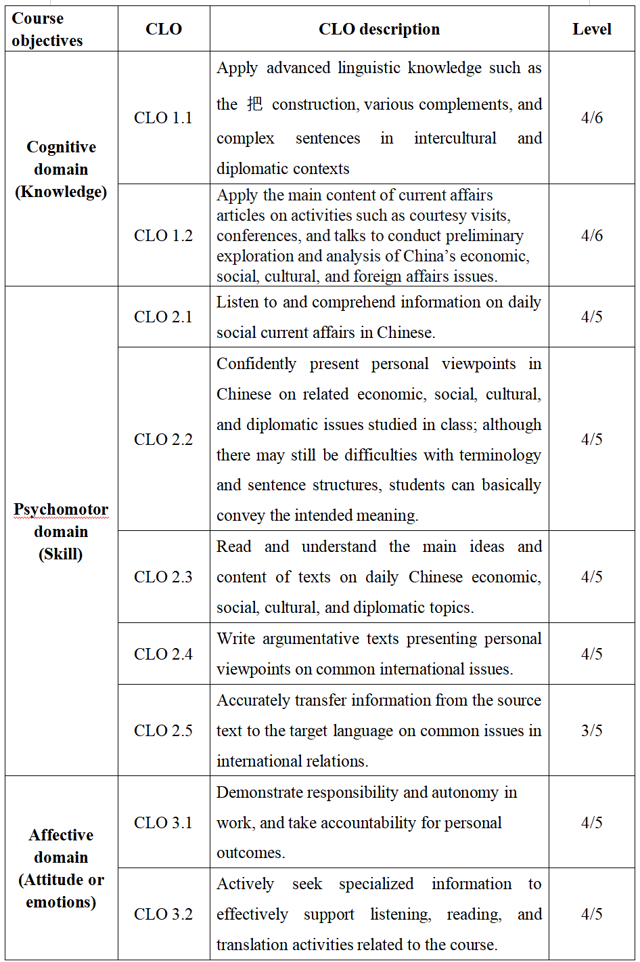
Note: The level is defined based on Bloom’s Taxonomy for Cognitive domain: Knowledge (1-6), Dave’s Taxonomy for Psychomotor domain: Skill (1-5), Krathwohl’s Taxonomy for Affective domain (1-5).
The above is a sample of the first major-specific course introduction. Additional Specialized Chinese Language for Specific Purposes’ courses can be supplied upon request.








Copyright ® 2026 Học viện Ngoại giao - Diplomatic Academy of Vietnam | Điều kiện | Bảo mật