

Dr. Le Dinh Tinh, Director General of the Institute for Foreign Policy and Strategic Studies, Diplomatic Academy of Vietnam, and researcher Lai Anh Tu published an article on The Diplomat about some developments in Vietnam's foreign policy after the 13th National Congress of the Party.
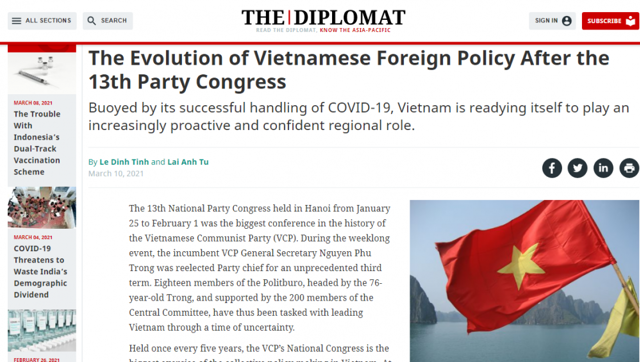
Held in Hanoi from January 25 to February 1, the 13th National Congress of the Communist Party was the largest Congress in the history of the Communist Party of Vietnam.
During this week-long Congress, General Secretary Nguyen Phu Trong was re-elected for a third term. Eighteen Politburo members, led by General Secretary Nguyen Phu Trong, along with 200 Central Committee members, were tasked with steering the nation through the current volatile period.
Held every five years, the Party Congress is the largest collective policymaking activity in Vietnam. At the Congress, delegates discuss and approve national security strategies, foreign policy, the strategy for national construction and defense, as well as selecting high-level personnel for the next five-year term and beyond.
Therefore, the foreign policy decided at the Congress has significant policy implications. The Resolution of the 13th Congress was passed with an absolute majority, emphasizing the importance of foreign policy.
More importantly, this resolution signifies a concerted effort to synthesize domestic support for Vietnam's foreign strategy, as 1,587 delegates attended the Congress representing all sectors, ministries, agencies, and localities nationwide.
For the first time in 15 years, four high-ranking diplomats were elected to the Party Central Committee, including Deputy Prime Minister and Foreign Minister Pham Binh Minh being elected to the Politburo. These highlights will help Vietnam promote coordination among ministries and adopt a comprehensive approach to foreign policy.
The Political Report of the 13th National Party Congress emphasized that Vietnam will continue to implement a foreign policy of independence, self-reliance, diversification, and multilateralization. The Report also re-affirmed the "Four Nos" principle in defense policy, where the ultimate goal is to protect the national-ethnic interests based on respect for international law.
Furthermore, the Report reaffirmed Vietnam's commitment to continue being a friend, a reliable partner, and an active, responsible member of the international community.
These guiding principles not only remain unchanged from the 12th Party Congress in 2016 but also add many nuances to the implementation of Vietnam's foreign policy over the next five years, indicating Vietnam's increasing proactiveness and confidence on the international stage.
Set against this broader backdrop, the recent Congress featured several notable new developments related to foreign policy.
The first and most notable point is the emphasis on the pioneering role of foreign policy in maintaining a peaceful and stable environment, maximizing external resources for development, and enhancing the nation's position and prestige.
This new development has two main components, implying that diplomacy needs to take a more central and active role in protecting Vietnam's sovereignty and territorial integrity, enhancing national capacity, and increasing Vietnam's international standing.
Similarly, this step acknowledges the importance and contribution of the foreign affairs sector in building a comprehensive national strategy for Vietnam. This new development also implies that diplomacy should be at the "front line" of national construction and defense.
Secondly, the 13th National Party Congress emphasized the need to build a "comprehensive, modern" diplomacy – encompassing three pillars: Party diplomacy, State diplomacy, and People-to-People diplomacy, as well as the fluent combination of these pillars.
By adding the concept of "comprehensive," Vietnam will explicitly promote all forms of diplomacy: political, economic, defense, public, cultural, and parliamentary.
Given the goal of developing a "modern" diplomacy, Vietnam is expected to increase investment in upgrading the capacity of its staff and diplomatic infrastructure, as well as promoting new initiatives such as "digital diplomacy."
Thirdly, while the Political Report of the 12th Party Congress focused mainly on identifying opportunities, the Political Report of the 13th Party Congress focused on a more dialectical and comprehensive assessment of Vietnam's strategic environment, identifying the challenges Vietnam might face in the coming decades.
While confirming that peace, independence, cooperation, development, and the 4.0 Industrial Revolution remain the world's major trends, the Congress also pointed out that great power competition, local conflicts, the rise of nationalism, and the adverse effects of globalization and international integration, along with many other challenges, could threaten Vietnam's security and development.
Fourthly, the 13th National Party Congress decided to elevate Vietnam's multilateral foreign policy, emphasizing Vietnam's role and participation in ASEAN, the United Nations, APEC, the Mekong sub-regional cooperation, and other regional and international cooperation frameworks.
In August 2018, the 12th Secretariat issued Directive 25, the first strategic document on elevating multilateral foreign policy. This is an important theoretical development in Vietnam's foreign policy, as multilateralism has always been a strategy to limit risks, avoid over-reliance on a few partners, while ensuring strategic autonomy and expanding Vietnam's network of friends and partners.
However, this does not mean that Vietnam's foreign policy will focus solely on multilateral diplomacy; instead, Vietnam will pursue a balanced combination of bilateral and multilateral diplomatic efforts.
Promoting and expanding relations with neighboring countries, strategic partners, and comprehensive partners, along with other important partners—in that specific order—remains the focus of Vietnam's foreign policy.
There are several key internal and external factors that can explain Vietnam's motivation to promote the aforementioned initiatives.
Firstly, the changes in foreign policy at the 13th Party Congress reflect a larger shift in the strategic thinking of Vietnam's leadership.
According to former Deputy Prime Minister Vu Khoan, one of Vietnam's leading foreign policy strategists, security, development, and influence have always been the three strategic goals Vietnam aims for.
In previous Congresses, Vietnam's security and development strategies always held a dominant position in policy discussions. Vietnam's former foreign policy was primarily formulated to promote these two goals.
Currently, Vietnam's foreign policy is also geared towards further enhancing the country's international position.
Vietnam's leadership also recognizes the need to increase the effectiveness of strategic planning by integrating foreign policy with various other policies to form a comprehensive national strategy until 2030.
Furthermore, future game-changing advancements in science and technology will require every nation to be more adaptable and flexible in foreign relations. Once again, the core values of independence, self-reliance, and balanced relationships with all great powers are emphasized.
Secondly, Vietnam's national positioning has changed since the 12th Party Congress. With increasing national capacity, Vietnam is moving toward a more proactive role in maintaining a peaceful and stable environment favorable for pursuing security and development goals.
Last year, Vietnam ranked 12th in the Asia Power Index 2020 due to increasing foreign policy influence, and 2nd in the Lowy Institute's COVID-19 Performance Index in Australia.
Economically, Vietnam is currently one of the fastest-growing economies in the region, deeply integrated into the global economy, highly open, and fully connected to the world trade system. Vietnam is currently a member of 16 free trade agreements, including the CPTPP and RCEP—the two largest free trade agreements in the region.
Politically, Vietnam has established Strategic Partnerships and Comprehensive Partnerships with 30 countries, including all five Permanent Members of the UN Security Council and all 10 ASEAN member states.
In 2020, Vietnam successfully fulfilled its role as ASEAN Chair amidst the COVID-19 pandemic. In its role as a Non-Permanent Member of the UN Security Council, Vietnam's initiative for an International Day of Epidemic Preparedness (December 27) was immediately adopted by the UN General Assembly.
Thirdly, the rapidly changing international strategic environment has brought Vietnam new opportunities and challenges.
For example, small countries in Asia, including Vietnam, must carefully assess the strategic shifts of great powers during the policymaking process.
In the Indo-Pacific region, strategic competition between the U.S. and China is escalating, putting Vietnam and other ASEAN countries at risk of being forced to choose sides.
Similarly, disputes and conflicts in the East Sea (South China Sea) are becoming increasingly complex. No single nation can solve other non-traditional security challenges such as the COVID-19 pandemic, climate change, and cybersecurity alone. Instead, international cooperation and diplomatic efforts are essential.
The increase in Vietnam's prestige and capacity has allowed it to pursue a more proactive foreign policy. Success in responding to the COVID-19 pandemic and economic growth through connectivity with the world and the region have contributed to the success of Vietnam's foreign policy.
Vietnam's prestige and position have also been enhanced by its efforts in addressing international and regional issues, through its leading role in ASEAN and its tenure as a Non-Permanent Member of the UN Security Council, its hosting of the second U.S.-DPRK Summit in 2019, and especially its increasingly active participation in UN peacekeeping operations.
In summary, these factors explain why Vietnam has decided to be more proactive and active in its foreign policy. However, Vietnam's success with these new policies will depend not only on its own efforts but also on the support and cooperation of its network of friends and partners.


Copyright ® 2026 Học viện Ngoại giao - Diplomatic Academy of Vietnam | Điều kiện | Bảo mật