

I. General Introduction
1. Historical Background
al Economy, and the History of the Communist Party of Vietnam.
In January 1963, the Faculty of International Relations was separated to form the Diplomatic and Foreign Trade Staff Training School. During this period, the school consisted of two faculties: the Faculty of Diplomacy (formerly the Faculty of International Relations of the University of Economics and Finance) and the Faculty of Foreign Trade. The Marxism–Leninism Department became an independent unit under the school, continuing to teach alongside other departments.
In 1965, the Faculty of Diplomacy separated from the Diplomatic and Foreign Trade Staff Training School to become the Diplomatic University. The Marxism–Leninism Department remained an essential component of the curriculum. On 19 May 1987, the Chairman of the Council of Ministers issued Decree No. 78-HDBT merging the Diplomatic University into the Institute of International Relations. On 1 August 1992, the Institute was renamed the Diplomatic Academy of Vietnam, as stipulated in Decision No. 279-CT, under the direct management of the Ministry of Foreign Affairs.
In the early 1990s, due to a temporary suspension of student admissions, the Department paused its teaching activities. Its lecturers were reassigned to other units or sent abroad for various missions.
From 1995 to 2005, the Department of Marxism–Leninism was re-established in 1997 to meet urgent teaching needs. In the initial years following reinstatement, the Department had very few lecturers, as many of its former staff had taken up new positions. To address this shortage, the Academy invited visiting lecturers from other universities. The Department maintained its previous scale of activities and effectively fulfilled its teaching and research functions.
From 2005 to 2008, following reforms by the Ministry of Education and Training, the Department expanded its curriculum. In addition to Political Theory subjects such as Philosophy, Political Economy, and Party History, the Department introduced general social science and humanities courses and content related to Vietnamese identity, including Introduction to Psychology, Introduction to Political Science, Introduction to Sociology, and History of World Civilization.
In 2007, the Department was elevated to a full faculty named the Faculty of Marxism–Leninism and Ho Chi Minh’s Ideology.
Since 2008, pursuant to Decision No. 82/2008/QD-TTg dated 23 June 2008 of the Prime Minister on defining the functions, tasks, and organizational structure of the Diplomatic Academy of Vietnam, and following the national standardization of faculty names across all universities and colleges, the Faculty was renamed the Faculty of Political Theory.
2. Mission
The Faculty delivers courses in Political Theory, equipping learners with a solid understanding of the ideological foundations of the Communist Party of Vietnam. These subjects enable students to develop correct political awareness, revolutionary will, a Marxist worldview and methodology, and the capability to firmly counter distorted or hostile narratives regarding history and the Party’s leadership in national development.
In addition, the Faculty offers general Social Sciences and Humanities subjects such as History of World Civilization, Introduction to Psychology, Introduction to Sociology, and Introduction to Political Science, thereby contributing to the foundational knowledge base for students across all academic programs at the Diplomatic Academy of Vietnam
3. Development Orientation
With a team of full-time and visiting lecturers of high professional caliber, the Faculty of Political Theory focuses on the development of a standardized Political Theory curriculum and the integration of updated, diplomatically oriented content. This approach aims to enhance students’ knowledge and to shape their analytical thinking through Political Theory and Social Science modules.
II. Organizational Structure and Academic Staff
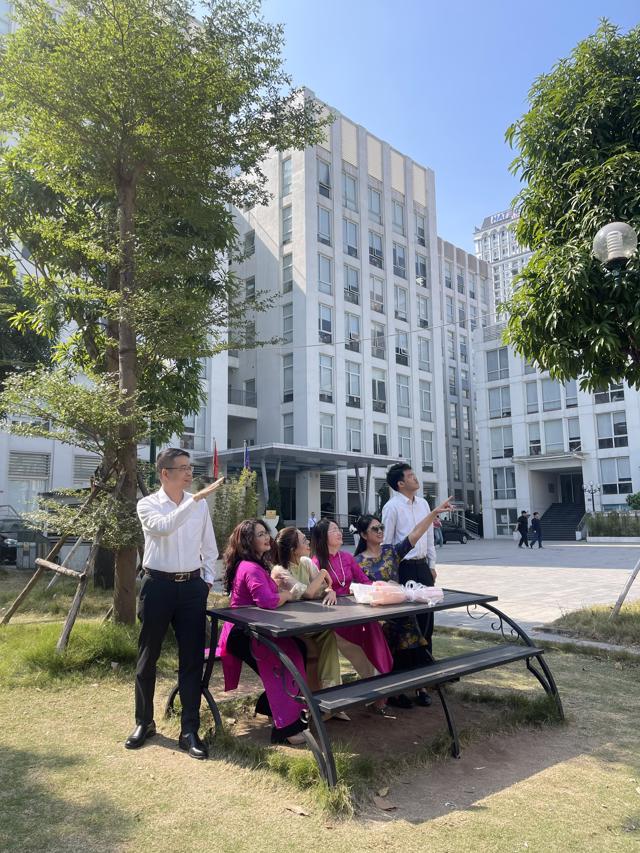
Leadership
Dean: Dr. Ly Thi Hai Yen
Email: yenlh@dav.edu.vn
III. Academic Programs
1. Training Tasks
Based on the Academy’s overall plan, the Faculty develops and implements its semester and annual plans. Tasks are assigned to lecturers and staff according to their qualifications, expertise, and training backgrounds, ensuring balanced workload distribution.
The Faculty is responsible for teaching Political Theory modules to undergraduate and postgraduate students across the Academy. It collaborates with the Academy to provide political and ideological education for staff, lecturers, and students.
It organizes scientific research activities and actively seeks research projects related to Political Theory and relevant fields in cooperation with domestic and international organizations and individuals.
It delivers Political Theory courses in accordance with standardized curricula and textbooks issued by the Ministry of Education and Training. The Faculty also implements training programs as directed by the Academy’s leadership; proposes improvements in teaching methods; develops plans for upgrading and maintaining teaching equipment, learning materials, and laboratory or practicum facilities; and enhances academic resources for students.
2. Courses Offered
Through its different development stages, the Faculty of Political Theory now offers nine courses, including core Political Theory subjects and foundational social science courses for all students of the Diplomatic Academy. These courses include:
3. Cooperation Activities
In the past, alongside full-time, in-service, second-degree, and graduate programs, the Faculty’s lecturers also taught supplementary courses for provincial-level officials and for staff of foreign embassies such as Laos and Cambodia. The Faculty collaborated with universities, including Hanoi Law University and Foreign Trade University.
In 2007, the Faculty organized a competition on Ho Chi Minh’s Ideology for students, selecting 20 outstanding participants for the program “Following President Ho Chi Minh’s Footsteps,” which enabled Diplomatic Academy students to engage in academic exchange with universities in Guangxi, China.
Currently, the Faculty continues to participate in scientific research with other departments and contributes to academic conferences and scientific councils at the Academy. Most lecturers have been trained at the Party School system (formerly Nguyen Ai Quoc School, now the Ho Chi Minh National Academy of Politics) or through domestic and international programs in Political Theory, Philosophy, or Marxist–Leninist studies at the postgraduate or doctoral level.
The Faculty also invites visiting lecturers, including Associate Professors, PhDs, and Master, from institutions such as the University of Social Sciences and Humanities (Vietnam National University Hanoi), Hanoi National University of Education, Hanoi University of Languages and International Studies, and the Banking Academy, to teach various subjects under the Faculty’s responsibility.
IV. Contact Information
Address: Rooms D624–D625, Building D, Diplomatic Academy of Vietnam,
69 Chua Lang, Dong Da District, Hanoi
Email: khoallct@dav.edu.vn
Facebook Page: The Quest of Philosophy
Link: https://www.facebook.com/khoalyluanchinhtri.dav


Copyright ® 2026 Học viện Ngoại giao - Diplomatic Academy of Vietnam | Điều kiện | Bảo mật