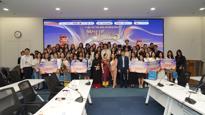


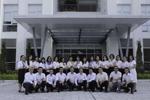
On the afternoon of May 25th, 2018, Galileo Society held a closing and awards ceremony of the Diplomacy Game - DAV Great Game 2018. The ceremony was attended by Dr. Do Thanh Hai, Head of Academic Skill Development as well as 7 teams in full strength from classes CT42C, LQT44C, DVB10, CT42A, CT44A, CT44B, and CT43C.
After a dramatic month, the first prize was awarded to the DVB10 team (playing the part of Turkey Imperial). That was a deserving award for wise negotiation efforts and strategic calculations of DVB10.
Sharing after winning the first prize of the DAV Great Game, Hoang Mai Linh (DVB10) said: “We feel that Diplomacy is an interesting game helping us gain more realistic negotiation experiences as well as practicing strategic thinking to execute our purposes. The continuous play also improved teamwork and time-management skills, ensuring the balance between learning and joining in the game.”
Diplomacy is a game that stimulates the European context in 1901 with the wars among 7 powers. It is an opportunity for the students to experience modeling international political environments, roleplay as strategists and diplomats. Thereby they can apply learned knowledge and skills to achieve specific targets.
By debrief method, Dr. Do Thanh Hai recognized and assessed the strategies of 7 teams, explained the relations between the situation of the game and the reality of international relations. In addition, Dr. Do Thanh Hai analyzed the situations, ways of communication, collecting, processing, and managing information, methods to train strategic thinking, negotiation, and crisis management skills.
In the closing ceremony, the teams had the opportunity to share the challenges and difficulties of overcoming complex situations which have high instabilities due to the participation of many countries, ways of thinking, and behaviors. Many conspiracies, secret agreements between countries gradually revealed, bringing interesting surprises to the players. The students also expressed their interest in having the opportunity to test the practicalities of the learned theories of international relations such as realism, constructivism, and liberalism.
The closing and awards ceremony took place in an exciting, open and amicable atmosphere, leaving a deep impression on all attendees.

Copyright ® 2026 Học viện Ngoại giao - Diplomatic Academy of Vietnam | Điều kiện | Bảo mật