

The UPM assesses universities’ performance based on eight groups of standards (fields) with 54 criteria with each’s own benchmark and weight, making an overall score of 1,000. Major groups of standards include strategic management (weights 6%), training (35%), research (20%), innovation (11%), innovation ecosystems (6 %), information technology and digital resources (10%), internationalization level (6%) and community service (6%).
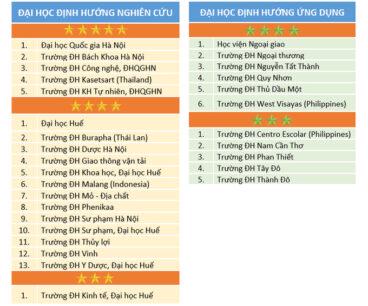
In the assessment criteria, the Diplomatic Academy of Vietnam excellently received two criteria of 5 stars in education and community service. The University Performance Metrics (UPM) is the product of Hanoi National University’s research group, which is led by Professor Nguyen Huu Duc and sponsored by the National Educational Science Program chaired by the Ministry of Education and Training.
Actual indicators of each criterion and standard are compared with the benchmark and star-rated (from 1 to 5 stars) to help generally verify, thereby analyzing each tertiary education institution’s strengths and weaknesses in its specific activities and fields.
Besides the Diplomatic Academy of Vietnam ranking first in the group, other application-oriented universities that also meet the 4-star standard, including: Foreign Trade University, Thu Dau Mot University, Quy Nhon University, Nguyen Tat Thanh University and West Visayas State University (Philippines).
According to the UPM's first year assessment results with 30 Vietnamese and ASEAN universities, the 5-star standard research-oriented universities include: University of Natural Sciences and University of Technology (under the National University Hanoi), Hanoi University of Science and Technology, Kasetsar University (Thailand).
“5-star universities can possibly reach Top 100 Asian universities that have top quality in the country and begin to establish their international reputations. 4-star universities are well-known in the country and the region. 3-star schools perform well in training functions according to market segments and can participate in the region’s student exchange”, shared by Professor Nguyen Huu Duc, head of the UPM.
Besides star-rating, the UPM also pointed out numerous differences between universities in Vietnam and in the ASEAN. For example, universities in the region place more emphasis on entrepreneurship, innovation, and digital transformation in strategic management. Meanwhile, the majority of Vietnamese universities hardly or newly pay attention to these issues.
Minister of Education and Training Phung Xuan Nha opined that the construction and operation of the system as a set of UPM indicators are very meaningful. First of all, it is the center of data and analysis that helps consulting for the national tertiary education system as well as domestic and regional universities.
According to Mr. Nha, tertiary education institutions can utilize the UPM's criteria to self-assess their performance, and use the UPM as a tool for strategic management, brand and partnerships development. Students would have accurate information about universities so that they can choose universities, fields and careers in accordance with their capabilities and strengths. Employers would have the basis to develop human resource strategy, recruitment plans and knowledge transfer cooperation.









Copyright ® 2026 Học viện Ngoại giao - Diplomatic Academy of Vietnam | Điều kiện | Bảo mật