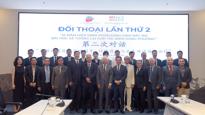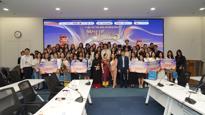

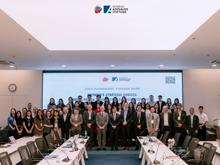
The dialogue between China Institute of Contemporary International Relations (CICIR) led by Prof. Vuong Tai Bang, deputy director and Diplomatic Academy of Vietnam (DAV) by Acting Director Dang Dinh Quy has taken place on 19 April 2011 at DAV. This is an annual panel discussion held alternately in each country to discuss international, regional issues and Vietnam - China relationship that lie in the two countries’ mutual concerns.
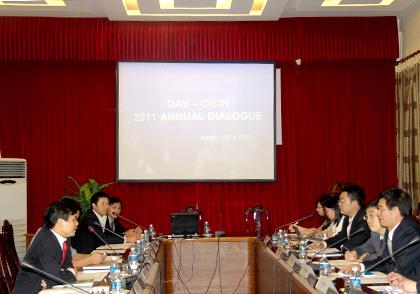
During the dialogue, participants assessed the situation of Chinese economic, social and political development recently, especially in the Chinese model of economy’s innovation process with the 12th five-year plan that Chinese Congress recently approved, and also expressed the confidence that the change in pattern of production, the paradigm shift from export-based economic development model to the internal demand exploitation one, the economy restructuring, high energy - consuming industry’s elimination, the promotion of new technology, high-tech manufacture, new energy, and new materials will help China enter a new period of development.
There are a number of views that after the financial crisis, the trend of multi-polarity and multi-center will develop faster. America’s role reduced relatively while the role of the EU, especially the emerging BRIC economies have increasingly been more prominent in the international arena. Scientists also focus on discussing the Middle East - North Africa, the situation of cooperation in East Asia etc…
The scholars agreed that the two nations’ bilateral relations have gone through the stages of development forming various mechanisms of bilateral and multilateral cooperation, contributing to the establishment of friendly cooperation environment. However, participants also raised the issues to be addressed in Vietnam - China relationship such as the protection of the Mekong River water resources, maintaining peace and stability in the South China Sea or Vietnam’s trade deficit from China. The participants proposed a number of recommendations and solutions that help promote, consolidate and strengthen bilateral cooperation in the future.
The dialogue held on the spirit of frank open exchange contributing to enhancing the understanding and trust amongst scholars from both countries and positively to bilateral relations in particular and regional cooperation in general.

Copyright ® 2026 Học viện Ngoại giao - Diplomatic Academy of Vietnam | Điều kiện | Bảo mật