


Team EDUNOVA with the project “EDUNOVA – Learning English through Real-Life Experiences”
Implemented by:
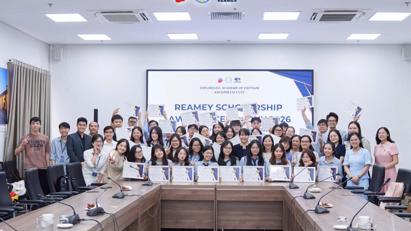
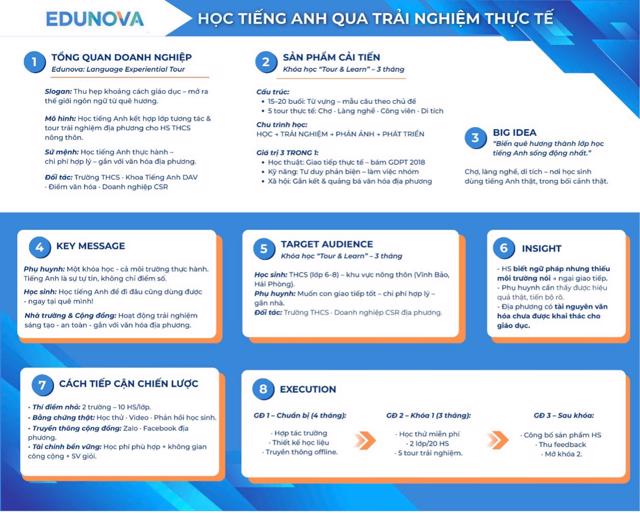
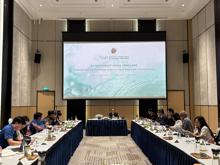
Within the framework of the competition “Students with Entrepreneurial Ideas in the Field of Education 2025” organized by the Faculty of English, Diplomatic Academy of Vietnam, Team EDUNOVA introduced the project “Edunova: Language Experiential Tour” – an experiential English learning model designed for lower secondary school students in rural areas.
Project Concept and Objectives
EDUNOVA is developed in response to a common challenge faced by many rural students: while they may possess basic grammatical knowledge of English, they often lack authentic opportunities to use the language in real-life contexts, resulting in low confidence and limited communicative competence.
The project aims to bridge the gap in learning opportunities between rural and urban students by integrating English learning into students’ immediate social and cultural environments. Rather than confining language learning to traditional classrooms, EDUNOVA brings English into everyday life through guided experiential activities.
The project offers a three-month “Tour & Learn” program, combining:
The learning process follows a cycle of Learning – Experiencing – Reflecting – Developing, grounded in Task-Based Learning and Experiential Learning principles, and aligned with the 2018 General Education Curriculum for English.
Key Values of EDUNOVA
EDUNOVA delivers three core values through its integrated educational approach:
In addition, EDUNOVA serves as a practical teaching platform for English language majors, particularly students from the Diplomatic Academy of Vietnam. Participating university students are involved in lesson planning, material development, classroom instruction, tour facilitation, and pedagogical problem-solving, thereby applying TESOL knowledge in real educational settings.
Feasibility and Development Potential
The project adopts a lean and flexible operational model, requiring minimal investment in physical infrastructure by utilizing existing public and community spaces. Small class sizes (10 students per class) ensure safety, personalized learning, and effective quality control.
EDUNOVA’s business model is designed to offer affordable tuition suitable for rural families, significantly lower than that of urban English centers, while maintaining strong educational value. With a clearly defined pilot–evaluation–expansion roadmap, the project demonstrates strong potential for scalability and replication in other localities.

Evaluation by the Judging Panel
With its experiential, community-based approach and strong emphasis on practical language use, EDUNOVA demonstrated high applicability and real-world educational impact.
As a result, Team EDUNOVA was awarded Third Prize by the Judging Panel, recognizing the project’s thoughtful design, social relevance, and potential contribution to equitable English language education.










Copyright ® 2026 Học viện Ngoại giao - Diplomatic Academy of Vietnam | Điều kiện | Bảo mật